
This page is from APP, the official source of professional practice for policing.
Every missing person incident occurs for a reason. Officers and staff should understand the circumstances to identify safeguarding needs and prevent further episodes. Going missing is often a symptom of underlying issues in a person’s life and may signal harm or vulnerability.
Specific missing persons investigations (appendix) provides additional information to support investigations in these circumstances.
Investigative strategy
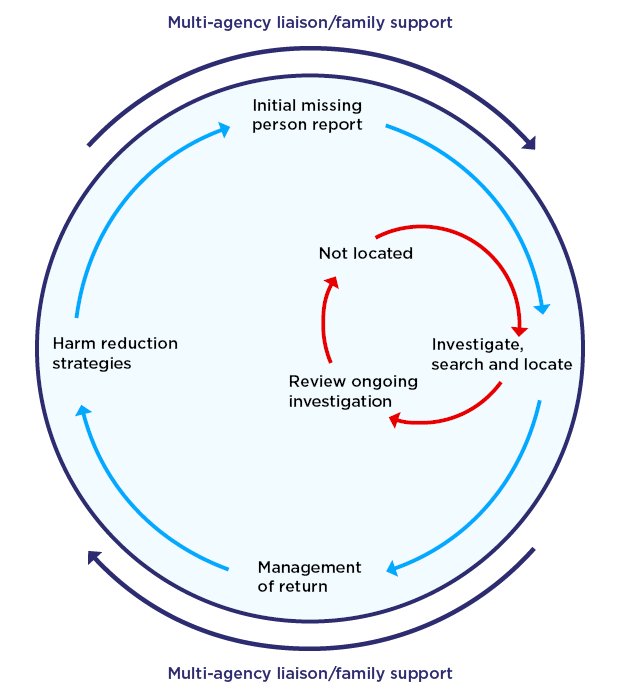
Investigators should follow a cyclical approach to missing person investigations, rather than a linear one. This means that enquiries, reviews and decisions are repeated as new information emerges, ensuring that risk is reassessed dynamically and actions remain proportionate.
A cyclical approach enables the police service to work effectively with other agencies. Forces should ensure that multi-agency processes are based on a problem-solving model, with clear communication and shared responsibility for safeguarding. Reviews should be built into the process to ensure that decisions are appropriate and that further enquiries are initiated when necessary. For further information, go to:
Hypotheses
Hypotheses at the start of an investigation may evolve as lines of enquiry are pursued.
While evaluating competing hypotheses can support the risk assessment process, evaluating hypotheses is not the same as evaluating risk. Risk assessment determines the level of harm that may occur and the likelihood of that harm occurring, whereas hypotheses provide possible explanations for what may have happened to the missing person. Supervisors and missing person specialists may use hypotheses to inform their understanding of the circumstances, but the two processes should not be confused.
When evaluating hypotheses, officers should identify objective factors that support or challenge each possibility. They should avoid assumptions that are not grounded in evidence. Officers should also consult with colleagues with relevant experience to improve the accuracy of hypotheses. Hypotheses can assist in shaping enquiries but should be evidence-based and continually reviewed.
All information gathered during each missing episode should be recorded accurately. This information provides intelligence for current and future investigations and supports wider problem-solving and safeguarding work. Officers should consider missing incidents in the context of previous missing incidents, not in isolation. Officers should explore the reasons behind repeat missing incidents and should analyse information to identify links between missing individuals, locations, associates and potential exploiters. In cases involving repeat missing persons, future lines of enquiry and safeguarding actions should be guided by details of previous locations, associates and circumstances.
Searching and multi-agency meetings are integral to the investigative process. Officers should ensure that these activities are documented and linked to the risk assessment and investigative plan.
The missing person case review process
Reviews are essential for maintaining investigative integrity and safeguarding. All missing person cases should be subject to regular review to ensure that:
- risk is reassessed
- actions are completed
- new lines of enquiry are identified
A detective supervisor should conduct case reviews, in addition to formal reviews carried out by those working closest to the case, as they have the necessary investigative expertise. In high-risk cases, the review should take place as soon as possible. In all other cases, the first review should occur no later than 48 hours after the report is made. The reviewing officer’s rank should be no less than detective inspector. Between detective reviews, interim reviews may be undertaken by patrol supervision, such as sergeants or inspectors.
The purpose of each review is to:
- review the level of risk, including information from social care and other sources when appropriate
- check for any outstanding and incomplete actions
- quality assure actions already taken
- set new actions and enquiries in order to bring the investigation to a successful conclusion
- make recommendations about the management and ownership of the investigation
- set future review date (or dates) as appropriate
All decisions and rationale should be recorded as policy decisions within the case record.
Long-term cases
In long‑term cases, where the missing person has not been located, officers and staff should ensure that risk continues to be reviewed and that any new information is acted upon. A senior officer trained as a senior investigating officer (SIO) should conduct formal reviews of cases open for 28 days or longer. Reviews should normally take place at:
- 28 days
- three months
- six months
- 12 months
- annually thereafter
The timing or frequency may be varied by the SIO where this is appropriate, based on the circumstances of the case, changes in risk or investigative complexity. Any significant new information should trigger an immediate review. Consideration may also be given to cold‑case reviews of outstanding missing person incidents.
Families and carers should be kept informed of progress in long‑term cases. Officers should agree how and when updates will be provided and should manage expectations regarding the review process and possible outcomes. Where all reasonable enquiries have been completed, families should be informed whether the case will continue to be reviewed periodically or closed pending further information. All contact with families or carers should be handled sensitively to minimise distress. For further information, go to Case closure.
Partial remains found
If partial remains of a body are found and they are believed to be that of a missing person a decision may be taken to discontinue the investigation. In such circumstances the missing person record may remain open to allow for the recording of any information concerning further remains that might be located in due course.
All unidentified body or people reports must be sent to UK Missing Persons Unit (UKMPU) within 48 hours of discovery. Go to the Unidentified cases section of this authorised professional practice (APP) for detail on how UKMPU can assist such cases.
If there is no likelihood of matching the person against a found person or body, the missing person case should remain inactive until authority to discontinue has been made by senior management. Authority to discontinue is likely to be granted when all potential lines of enquiry have been explored. Further advice can be sought from the UKMPU.
For further information, go to the Found remains or people section of this APP.
Cold-case reviews
Advances in forensics, technology and information sharing capabilities mean that cold cases should be reviewed to determine the potential for further investigation that may resolve the case. The extent and timing of any review will necessarily depend on the circumstances of the case. Advice and support can be obtained from the UKMPU.
In unsolved missing person cases that are over a year old, forces should seek to process and retain records of as many of the available forensic identification samples as possible. Any reasons why a forensic sample is not available should be documented. Where an individual has been missing for a number of years and a direct DNA profile from belongings or medical samples is not available, consideration should be given to obtaining profiles from family members. For further information, go to Identifying missing persons globally through family DNA matching.
Critical incidents
Any incident where the effectiveness of the police response could have a significant impact on public confidence should be designated as a critical incident. For information, go to Critical incident management APP.
If an investigation develops into a major enquiry, investigators should consider transferring the record to the relevant case management system (such as HOLMES).
Search strategy
Search activity is a critical component of missing person investigations. It should be proportionate, documented and guided by risk assessment and investigative priorities.
A search of the location where the individual went missing from and/or their home address should be conducted in all cases, unless there are specific reasons why this is not appropriate. The reporting person may be asked to conduct this search on behalf of the police where proportionate to the circumstances.
The extent and intrusiveness of the search should be dictated by the circumstances and purpose. All searches should be fully documented, including:
- the reasons for the search
- the extent and areas covered
- what has not been searched
This ensures that accurate information is available for any future searches. Investigators should conduct the search with compassion, taking account of the needs of the family and local community.
The investigating officer should seek advice from a police search adviser (PolSA) or initial missing person search adviser (IMPSA) when developing the search strategy. While non-police resources may be used, such as volunteers or search and rescue teams, overall responsibility for managing the search remains with the police.
The search strategy should be guided by the Missing person search e-learning on College Learn (you will need to sign in). This provides guidance on the techniques required when searching for a missing person.
Legal powers
Most searches are conducted with the consent of the owner or occupier of private premises or land. Where consent is not given and there is information suggesting an imminent risk to life or significant harm, officers have the power to enter premises under section 17 of the Police and Criminal Evidence Act 1984. In all other circumstances, a warrant is required to enter and search private premises without permission. For further information, go to Police powers to enter and detain.
For further information relating to the Mental Health Act 1983 powers, go to:
Open-door and intrusive searching considerations
Open-door searching involves checking all spaces within premises where the missing person could reasonably be found. Where relevant suspicions exist, a more intrusive search may be necessary. This should be conducted under PolSA or IMPSA supervision. The purpose of such searches is to locate the missing person or identify information that could assist, such as diaries, notes, computers or phones.
Additional resources to support the search for missing people
Guidance on the search for vulnerable missing people (children and adults) and the investigation of suspicious missing person cases is available within the Appendix.
Fire and rescue service
Early consideration should be given to the resources required to conduct effective searches. Under a national protocol agreement, the fire and rescue service can assist the police in searches for high-risk missing persons.
Volunteer search teams
Volunteer search teams may provide valuable assistance.
The police will retain overall responsibility for the search. Where appropriate, a coordinator should be appointed to assist with the management and direction of any volunteer teams.
Maritime and Coastguard Agency
The police service is recognised as the authority that coordinates the response to an incident on land. The Maritime and Coastguard Agency (MCA) has responsibility for the initiation and coordination of civil maritime search and rescue, and will assist the police on request. Civil maritime search and rescue is defined as being in the area below the high-water mark. The MCA may also assist further inland, and this can be coordinated via the Aeronautical Rescue Coordination Centre (ARCC).
Aeronautical Rescue Coordination Centre
The ARCC for the UK and territorial waters is based at Kinloss Barracks and controls helicopters and other aircraft from a number of RAF stations. They are usually called by the MCA for assistance in sea-based incidents but are also available for land-based lifesaving operations.
Additional information that may inform or assist in the search for a missing person is available via the following links:
- Working with victims and witnesses APP – taking effective witness reports
- Investigation process APP
- Financial investigation APP – electronic, financial and communications enquiries
- Media relations APP – sightings provided as a result of publicity
- AWOL patients APP – arrangements for the return of hospital inpatients
- Economic and Social Research Council (ESRC) – Geographies of missing people: Processes, experiences and responses
Public sightings
Investigators should manage and assess sightings reported by the public in the context of the overall investigation. All sightings should be recorded using an appropriate system based on the seriousness of the case and force policy. This may include:
- the missing persons database or application
- the force command and control log
- the HOLMES system for complex or serious crime investigations
The reliability of each sighting should be evaluated. Officers should seek corroboration through means such as closed-circuit television (CCTV), financial transactions or telephony data, in line with relevant authorities to do so. Where multiple sightings are received, officers should consider mapping them by date and time, which may identify clusters that require further investigation.
Sightings should be assessed alongside other information gathered during the investigation, and the rationale for any actions taken should be documented. In high-profile cases where large volumes of sightings are received, forces should implement a grading and prioritisation process to manage resources effectively.
For further information, go to:
- Information management APP
- Missing people sighting report form
- Missing people sighting evaluation form
Rewards
Offering rewards can encourage public engagement and reinvigorate media interest in a missing person case. However, forces should carefully consider any offer of a reward before acceptance. Investigators should assess the potential impact on resources, as all information received will require evaluation and corroboration. Decisions regarding rewards should be documented. Any associated communication strategy should be aligned with the overall investigative plan.
Forensic strategy
Investigators must give early consideration to obtaining identification material. Acquiring this in a timely manner ensures that:
- opportunities to obtain it are not lost
- families do not have to be revisited at a later date, which may cause additional distress
- individuals can be promptly eliminated or matched to any unidentified remains which may be found
For further information, go to Code of Practice on the Collection of Missing Persons Data.
Timescales for collecting samples
The timescales for taking samples reflect the need for proportionality against the perceived risk to the missing person. Failure to collect the samples reasonably quickly reduces the opportunity for gathering them. The following timescales have been derived as a result of professional expertise:
- High-risk missing person – samples to be obtained within 24 hours.
- Medium-risk and low-risk missing person – in relevant cases, samples to be obtained within seven days. 'Relevant’ means where obtaining the samples is, or could become, relevant to the investigation.
Where a case is escalated from very low risk, officers should consider obtaining samples promptly. Officers should retain and submit samples collected in long-term cases (where the person has not returned within 28 days) to the appropriate database. Where there is an immediate investigative need, officers should submit samples as soon as that need becomes apparent.
The table in the following section shows the range of suitable identification samples and describes which database should be used to store them.
Identification samples
The police standards of investigation should be adhered to when collecting identification samples. This will ensure that no contamination occurs and the best possible samples are obtained, which will give the greatest opportunity to identify the individual.
Only forensic service providers accredited to load DNA profiles to the National DNA Database should be used to obtain a DNA profile. The samples should be submitted for profiling as soon as they are taken.
| Type of sample | Database |
|---|---|
| DNA (reference profile from the person or their possessions, and kinship inferred samples derived from family members) | Missing persons DNA database (requires UKMPU HERMES reference) |
| Fingerprints | Ident1 |
| Palm prints | Ident1 |
| Footprints (plantar impressions) | Ident1 |
| Dental charts | UKMPU National Dental Index (hard copy and electronic copy retained by the UKMPU) |
Officers should consider obtaining as many different forms of identification as possible. Depending on the circumstances of body recovery, any one or multiple of the primary identifiers may not be appropriate or relevant. For example, this may be due to the state of decomposition, or if only partial remains have been located. Individually, dental records and DNA are considered particularly enduring. However, officers should attempt to obtain as many biometric opportunities as possible. This will ensure the best chance of being able to make an identification if and when a body is recovered.
For further information, go to Identification evidence.
Obtaining consent
If the individual is alive, consent for identification samples to be taken should be obtained.
If the individual is unconscious or concern is raised regarding their ability to provide consent, an appropriate health professional involved in their care should be consulted. Assessment methods (such as the Gillick Competence) can be applied to ensure informed consent is obtained appropriately (go to Mental capacity).
Identification of a body or partial remains
When a body or partial remains are found, appropriate samples should be obtained as soon as possible in order to identify the individual. Where available, all the samples listed in forensics should be obtained to maximise the possibility of successful identification. For further information, go to the Unidentified cases section of this APP.
Lifestyle information
Information known about the individual and their lifestyle should:
- guide the investigation
- contribute to risk assessments
- assist with identifying the possible reasons (or hypotheses) for the person’s absence
Further enquiries may challenge or establish the validity of the hypotheses. It is important to build up a comprehensive picture of the person’s family, friends, behaviour, hobbies and habits (or ‘lifestyle’) as soon as possible. Within major crime investigations, this is often referred to as victimology and is generally the responsibility of the family liaison office (FLO).
Digital enquiries
Digital enquiries are an important aspect of a missing person investigation. Information gathered about the person’s online activity may provide crucial clues about their intentions and possible destinations while missing, but the police do not always have the legal right to access this information.
Individuals have the right to privacy and do not have to inform their families and friends about their whereabouts. Police officers must consider the rights of a missing person and respect their private and family life. Investigators should consider the necessity and proportionality of any action (such as investigations into personal data), given the intrusive nature of such enquiries. Access to such data may often be justified based upon significant safeguarding concerns, or in order to determine if or what crime has occurred. It may be necessary to apply for authority to recover communications and other data under the Regulation of Investigatory Powers Act 2000 and Investigatory Powers Act 2016.
Accessing computer-based information
Accessing computer-based information should only be carried out by individuals who are trained and authorised to do so. Unauthorised access, such as turning on a smartphone, can alter or destroy data. It may constitute unlawful interception if a message is received during access without the appropriate authority.
The approach to collating computer-based information should follow the same principles as any other criminal investigation. Where there is no suspicion of criminal involvement and the device is shared, consent from the owner may be sufficient to identify further lines of enquiry. If there is any uncertainty, investigators should apply the established principles for handling computer-based evidence.
For further information, go to:
Social media and open source enquiries
No legal authority is required to view information that an individual has made publicly available on a social media site. However, regularly reviewing and recording a person’s information may be deemed to be surveillance, and could require Regulation of Investigatory Powers Act 2000 (RIPA) authorisation.
Investigators should be aware that viewing such information can be traced back to the computer used. Personal equipment, such as smartphones, should not be used to conduct online enquiries. Where involvement in criminality is suspected, advice should be sought before any online work is undertaken.
Where criminality is suspected, or direct access to a missing person’s social media profile is being considered, investigators should seek immediate advice from at least one of:
- the force communications data single point of contact (SPOC)
- the Covert Authorities Bureau (CAB)
- the National Crime Agency (NCA) Major Crime Investigative Support team (telephone 0345 000 5463)
Even if consent has been granted from the next of kin, this advice should be sought.
When social media is identified as relevant to the investigation, investigators should consider contact with the platform provider with authorisation under the Investigatory Powers Act 2016. Investigators should consult local force policies and contact the force communications data SPOC.
For further information, go to:
- Knowledge Hub internet intelligence and investigations practitioners group (you will need to sign in)
Communications data
Where there is significant concern regarding the person's wellbeing, investigators should consider accessing live-time communications data, (for example, cell site). Officers and staff should consult local force policies and procedures to apply for communications data. Communications data enquiries in missing persons investigations are prioritised according to urgency and risk to life. The National Priority Grading System (NPGS) should be applied to support applications for communications data from communication data providers.
| Grade | Description |
|---|---|
| Grade 1 | An immediate threat to life. |
| Grade 2 | Exceptionally urgent requirement for the prevention or detection of:
|
| Grade 3 | Matters that are not urgent but, where appropriate, will include specific or time-critical issues, such as:
|
For further information, go to:
- Communications Data Code of Practice
- Introduction to communications data (you will need to sign in to College Learn)
Passive data enquires (CCTV and ANPR)
Passive data can be an important aspect of a missing person investigation. Early capture of CCTV around the home address, last known location, and/or place the individual is missing from can be crucial to identify relevant lines of enquiry and develop the search strategy. Images obtained from CCTV may also prove valuable for media purposes, especially where a recent photograph of the individual is not available.
Where appropriate, data from automatic number plate recognition (ANPR), vehicle tracking systems, and phone satellite navigation can assist in building a picture of the missing person’s movements and lifestyle. Understanding where the individual has travelled recently, or during previous periods of absence, may provide important clues about their possible location.
For further information, go to Passive data generators.
Financial enquiries
Where there is a concern for a person’s welfare, the following financial records can provide information about an individual’s lifestyle and location, and indicate whether they are alive:
- bank accounts
- loyalty cards
- pensions and benefits claims
These financial records should be accessed with appropriate authority.
An accredited financial investigation officer (FIO) will be able to offer the investigating officer (IO) advice on how this information can be:
- accessed
- used to support the investigation
- used to develop an effective investigative strategy (go to Using financial information)
Financial enquiries to banks and financial institutions apply similar thresholds to communications service providers. Officers must ensure that any request for information complies with legal requirements and does not breach privacy. Before making a request, officers should assess whether there is:
- a real risk to the person’s safety
- any indication that the report may be malicious – for example, where the report is made in the context of domestic abuse
Officers should only request information that is necessary to safeguard the individual or support the investigation.
It may also be possible to obtain previous bills or bank statements during the search of the home address, in order to build up this understanding.
Proof-of-life enquiries
There are various government and private organisations that may hold information relevant to the investigation. These may include:
- the Department for Work and Pensions (DWP)
- the Driver and Vehicle Licensing Agency (DVLA)
- the Passport Office
- GP and hospitals
- vehicle recovery services (for example, the AA and RAC)
- car rental companies
Checks with these organisations can assist in establishing whether the person has chosen to disappear or if harm has come to them. The extent to which these enquiries are pursued will vary, depending on the circumstances of the case. Enquiries with these organisations should be proportionate, based on a realistic assessment of the circumstances of the disappearance.
While they may be crucial in no-body murder investigations, a standardised approach is not likely to be beneficial or necessary in many cases.
For further information on how to conduct these enquiries, go to:
Case analysis
Investigators should consider case analysis in appropriate missing person investigations, particularly where the reasons for the disappearance are unclear or significant harm is suspected. Case analysis is an investigative technique that examines the circumstances of the disappearance to support decision-making and identify further lines of enquiry.
The process should identify information gaps and enable targeted enquiries to fill those gaps. This will help to ensure that a comprehensive picture of the individual’s lifestyle, habits and circumstances is developed. Investigators should use analysis to highlight areas of concern for the person’s wellbeing, whether they may be a victim of crime or have come to harm through their own actions. Developing a subject profile should be considered as part of this process.
A sudden cessation of habitual activities undertaken prior to the disappearance should be treated as a potential cause for concern. This information can be used to substantiate requests for data or assistance from other agencies. The level and extent of analysis should be proportionate to the circumstances of the case. Although initial information may suggest that detailed analysis is unnecessary, supervisors should review this decision as the investigation progresses and new information emerges.
Management of return
Effectively managing the return of a missing person should be considered as part of the investigation. The investigation cannot be concluded until the full circumstances of the disappearance have been explored and appropriate safeguarding measures put in place. Understanding the reasons why the person went missing should inform future prevention strategies and assist in locating them if they go missing again.
When the missing person is located, officers should undertake a prevention interview to identify ongoing risk factors that may affect the likelihood of the individual going missing again.
Effective management of a person’s return is important because the person may have:
- been the subject of crime or otherwise been at risk of harm
- gone missing in order to harm themselves or take their own life
- been unsafe or at risk owing to their inability to look after themselves properly due to age, incapacity or other reasons
- been the perpetrator of crime
The approach to managing the return will be determined by the risk assessment. The following points may need consideration.
- Should a multi-agency consultation or strategy meeting be held to decide what will happen next?
- What is the best engagement process when the person is found and who should talk to them?
- Where will they be accommodated?
- Are any further interventions or support needed? Go to the Support services section of this APP.
- Who is the person best suited to conduct the return interview and when? For example, arrangements for children based in accommodation outside of the force area, who will not be returned to the original force that recorded them missing.
There is no requirement to create a missing person record on the force case or record management system if the incident was delayed and both:
- the individual either returned or was located before the review point
- the reporting person has no ongoing concerns
In these circumstances, a bespoke closing code should be used to close the incident log, so that all reports that do not result in a formal missing person record can be monitored and audited.
For further information, go to:
- Code of Ethics
- Appendix: Missing children
- NPCC: Police duties and powers when a missing person is found
Accommodation
Investigators should consider whether it is appropriate to return the missing person to their home address or the location they went missing from. Planning for accommodation should take place before the person is found, as waiting until they return may result in missed opportunities to prevent future episodes. Strategy discussions should include appropriate levels of supervision, as well as alternative accommodation where necessary.
Confidentiality
Police officers must be mindful that when a missing person is located, their whereabouts must not be disclosed to others if this is against their wishes. For adults, the police must not reveal their location to the person who made the report, or to family or friends, unless the individual has given consent.
Officers may need to share the individual’s location with other authorities or services if this is necessary to:
- prevent significant harm
- address a real and immediate risk to their safety
For children, officers should inform parents or those with parental responsibility of the child’s location.
The police should inform the person who reported them missing that they have been located. It is possible that the person making the missing person report has an ulterior motive for submitting a report.
Interviews
Prevention interviews and independent return interviews can provide an important opportunity to identify ongoing risk factors that may affect the likelihood of the individual going missing again. They should not be treated as simply administrative procedures to close a missing incident.
Prevention interviews are usually conducted by the police and are different to return interviews, which are often provided by third-sector partners. The learning points from any interviews need to feed into the police systems to improve the response to that individual if they go missing again.
For further information, go to the NPCC Advice to police forces on prevention interviews and independent return interviews.
Prevention interviews
The police have a responsibility to ensure that the returning person is safe and well. The purpose of the prevention interview is to identify any ongoing risk or factors that may contribute to the person going missing again. Prevention interviews should therefore be carried out in all high-risk and medium-risk cases. They should also be considered for very low-risk and low-risk cases. The interview provides a valuable opportunity to find out useful information that may indicate harm suffered by the returning person. It can also identify details that may help trace the person in the event of a future missing episode.
Supervisors or missing person specialists may exercise discretion not to carry out prevention interviews in very low-risk or low-risk cases. They may also exercise discretion not to carry out prevention interviews in cases where both:
- the missing person returns or is located prior to police deployment
- the reporting person is satisfied that the person has not suffered harm or been exposed to harm while absent
However, before applying this discretion, an assessment of the circumstances should be completed to determine whether visiting the returning person would add value.
This assessment should consider:
- the circumstances of the disappearance
- what is known about the person’s experience while missing
- the potential to gather information useful for future investigations
The interviewer should:
- check for any indications that the person has suffered harm
- establish where and with whom they have been
- provide an opportunity for them to disclose any offending against or by them
Forces should determine the most appropriate method for conducting a prevention interview, considering necessity and proportionality. In some cases, the adverse impact of police attendance may mean that someone other than a police officer should conduct the interview, or that the interview is carried out remotely via video or telephone.
When considering an external body to carry out an interview, it is important to ensure that all relevant information is passed back to policing, so that:
- risk of harm to that person or anyone else is addressed
- this can inform any future missing person enquiries involving this person
In reaching a decision, it is important to consider:
- the full circumstances of the missing incident
- the harm or potential harm
- the impact of police involvement on the individual
Timing of the prevention interview
A prevention interview should be carried out as soon as practicable after the person has returned, taking into account their welfare and immediate needs. It is important to identify the right person with the appropriate skills to conduct the interview. Doing so maximises the opportunity to gather information that can inform safeguarding and prevention work. If the interview reveals that the person has been harmed or is at risk of harm, appropriate safeguarding action should be taken.
Professional experience suggests that some missing persons, particularly children, may be unwilling to engage in the process. If this occurs, officers should record:
- the person’s demeanour
- their physical state
- their clothing
- any other relevant factors
This information may assist in any ongoing criminal investigation or care planning.
Further investigation should be considered where risks are identified, and where there is a likelihood that the person will go missing again. Investigators should create a trigger plan to guide future responses.
Frequency of checks
Where a person goes missing frequently, particularly from a care setting, it may not be practicable to conduct an interview every time. In these cases, officers should agree a proportionate approach – for example, conducting one interview per day at a convenient time.
A joint decision should be made between police and those responsible for the child’s care regarding the frequency and method of prevention interviews. As previously stated, the person conducting the interview should have the appropriate skills and experience to engage effectively and gather relevant information. For further advice on prevention interviews for children, go to the Appendix of this APP.
Independent return interview
Police forces should work with local authorities to ensure that independent return interviews are always offered to children who have been missing. In England, the legal responsibility sits with the local authority. However, it is expected that police forces will work with their partners to ensure that these are completed and that information is shared.
Where available, the independent return interview should be provided by a professional from an independent agency. This agency could be an independent advocacy service or specialised runaways’ project. The professional should be:
- trained to carry out these interviews
- able to follow up any actions that emerge with the authority responsible for the individual’s care
Forces should establish a process for providing return interviews where individuals are deemed to be vulnerable and/or at risk of harm. Following the return of the missing person, individuals should be offered the opportunity to engage in a more in-depth interview, in order to do the following:
- Identify and deal with any harm they have experienced, including harm that might not have already been disclosed as part of the police prevention interview. Any medical conditions should be discussed and any need for medical attention should be assessed.
- Understand and try to address the reasons for the disappearance.
- Try to prevent it happening again.
The information gathered from the interview helps professionals to understand the reasons why the person went missing and to take action to prevent future missing episodes. It is important that a process exists to share information in line with national guidance gathered from these interviews with partners (go to Multi-agency protocols).
For further information, go to:
- APP on information sharing
- Information Commissioner’s Office (ICO) – A 10-step guide to sharing information to safeguard children
Timing of independent return interviews
The independent return interview should take place without undue delay and preferably within 72 hours of the person being located or returned.
Delays in return interviews may result in:
- the retraction of statements and disclosures
- a loss of evidence
- a loss of confidence in police response
Information and intelligence supplied by parents and carers, such as details of telephone calls or messages on mobile phones, can be very relevant and should be recorded.
Indicators of exploitation or harm
Officers should note any indicators that the individual has come to harm or may be the victim of crime. These indicators should be escalated for further investigation as relevant.
Where evidence is identified that the person may have been exploited, radicalised or otherwise harmed by a third party, officers should make referrals to the appropriate specialist team for investigation and pursuit of suspects.
The following guidance has been developed to support investigators in cases where it is suspected that a child may be at risk of abuse, neglect, exploitation, abduction, forced marriage or radicalisation:
- Indicators of concern for a child
- Risk identification
- Action in urgent or serious cases
- Child sexual exploitation APP
- Forced marriage and ‘honour’ based violence APP
Care planning on return
For looked-after children and some vulnerable adults, reviewing their care plan is an important element of managing their return from a missing episode. Although this is not the responsibility of the police, it is important for police officers to share any information with partners that may influence the care plan.
Care planning involves a comprehensive assessment of the individual’s needs and takes into account their wishes, feelings and aspirations for their future. The care plan should be used to decide which placement will be most appropriate (for example, foster care or residential home).
Case closure
It will not usually be appropriate for missing person cases to be closed without the individual being seen by the police or a relevant professional. An exception is where the investigation indicates that there are no suspicious or concerning circumstances, in accordance with Article 8 of the ECHR. Go to the Legal requirements section of this APP. It is important that the appropriate closing code (for command-and-control systems) is used to identify the incident as a missing person.
In circumstances where the missing person has been located, but it is impractical to see them owing to their present circumstances, the case can be closed if a member of the senior management team authorises this. For example, the missing person may be abroad or deliberately making themselves unavailable to police.
For further information, go to the Missing person case review process.
Not found
Where the missing person has not been found, decisions will be taken by the IO as to whether the case remains an active investigation and the subject of review. Decisions will be based on the investigation and circumstances of the case. For example, it may be considered that the person has left home or lost contact of their own accord.
Family support
The police should consider how best to support the family and carers of the missing person during an investigation.
While it may be practical for missing person investigations to be managed within uniformed response, this may not always meet the needs of families and carers. Rotating ownership of the investigation through a 24-hour shift pattern may not allow for a consistent point of contact. In the early stages of an investigation, officers should ensure that there is a nominated point of contact available to the family or carers at each shift change. The family or carers should be informed of whom this is.
Consideration should be given to appointing a single point of contact (SPOC) where:
- an investigation continues beyond the initial stages
- risk, complexity or family need indicates this may be necessary
Decisions about appointing a SPOC should be based on professional judgement and kept under review as the investigation develops.
Police actions in relation to support for families
The trauma associated with a missing person investigation may place families under immense pressure and stress. Investigators are likely to require them to provide detailed information and there may also be public and media interest.
The information required by families and carers of those reported missing will depend on the circumstances of the case. However, police officers or staff with responsibility for investigating a missing person report should support their needs by doing the following:
- Providing a SPOC (whom they can realistically contact) and provide regular updates.
- Informing them of support services. This information may be provided as a leaflet or similar that includes details of the role of the Missing People charity.
- Listening and responding to any concerns that they may have about the investigation. Officers and staff should recognise the importance of the incident and investigation to families and carers.
- Managing their expectations by giving realistic updates on what is being done and how an investigation is being conducted. This includes any limitations that may be placed on it.
- Ensuring that they are made aware of any media releases and press conferences before they take place.
- Maintaining contact in long-term cases and informing them of reviews.
- Providing a family liaison officer (FLO) in appropriate cases.
- Discussing social media aspects with the family. For example, this could include whether social media could be effective in taking the investigation forward and whether this will leave a difficult and unwanted footprint.
For further information, go to:
- Working with victims and witnesses
- Factsheets for families
- Experiences of reporting missing people
- Family support – Missing People
Family liaison officers
An FLO may be assigned to support a family. Their primary purpose is to assist the senior investigating officer (SIO) with the exchange of information between the SIO and the family members.
FLOs are not routinely assigned to missing person enquiries. However, they may be used in some cases.
For further information, go to Working with victims and witnesses.
Managing affairs
When someone goes missing, families can experience additional stress associated with the practical difficulties resulting from their disappearance. Where the person has been missing for some time, or the circumstances indicate the person may have died, a family may wish to resolve their relative’s affairs using presumption of death legislation. The charity Missing People is able to provide advice and support to families considering this, and has produced guides to assist.
Where a family is going to make a presumption of death application, forces should ensure that they have:
- completed all reasonable lines of enquiry
- considered all opportunities to locate the individual (alive or dead)
The force should then:
- contact the UK Missing Persons Unit (UKMPU) to review the case
- ensure that no unidentified bodies or remains have been located
- provide reassurance to a court that the person subject to the application is no longer alive
Communication strategy
It may be necessary and appropriate for police investigators to release information publicly during missing person investigations to:
- appeal for information
- respond to media requests for information
- inform the public
- enable accurate reporting and manage speculation or misinformation
- maintain public confidence in policing activity
In the case of appealing for information and responding to media requests for information, investigators should ensure that all information provided is accurate. This includes descriptions of the missing person, clothing, vehicles and last sightings. Go to Image of missing person for guidance on releasing images of missing persons.
A communication strategy should be developed in all high-profile or sensitive cases, and where the family have instigated their own public appeal. The objectives of the communication strategy are to:
- generate information
- raise public awareness
- maintain public confidence
- manage speculation
It will not be appropriate to issue a public appeal in every case. When a public appeal is appropriate, consideration should be given to:
- the purpose of using publicity
- the associated risks
- what types of appeals are best suited to aid the investigation
- which channels are best suited to aid the investigation
Investigators should seek advice directly from their corporate communications department.
When determining the communication strategy, investigators should assess the potential impact on the community. A missing person critical incident is different from other incidents and will require additional considerations. This is because the nature of the investigation is likely to generate public interest over a number of days.
Careful management of messaging and media engagement will help to ensure that information is newsworthy and that any interference with the investigation is minimised.
If the police wish to issue a public appeal as part of an investigation, the missing person’s family or carer should be consulted. The use of publicity may still be considered when consent has not been provided, However, the IO must ensure that:
- the decision is made with consideration for the Human Rights Act 1998, Data Protection Act 2018 and UK General Data Protection Regulation
- any publicity is carried out proportionately
- actions taken are in the best interests of the welfare of the missing person
For further information, go to:
- Media and communications APP
- Missing person media appeals
- Missing persons media and online publicity
- Missing person publicity guidance (accessed via Knowledge Hub, you will need to sign in)
Looked-after children
Particular care should be taken when issuing publicity in cases involving looked-after children. Some addresses are confidential and in certain circumstances, birth parents may not know where their child is living. For this reason, any public appeal must be developed in partnership with the local authority. All risk factors should be fully explored before any publicity is considered.
In addition to direct appeals and use of local media, investigators may also consider partner channels.
Missing People
The charity Missing People offers extensive local and national opportunities to assist forces with publicity. Even when the charity has not been directly involved in the publicity, many people contact it with important and relevant information, particularly in cases that attract widespread media coverage.
Forces should establish and maintain communication links with the Missing People charity to ensure that case information is shared and managed effectively. Missing People operate the Safeguarding Briefing Network, which sends targeted briefings to relevant agencies to facilitate the search for missing people.
Family-initiated publicity campaigns
Investigators should be aware that families or friends may choose to use social media or involve the media. If an investigator believes that such publicity could adversely affect the investigation, this should be explained to the family or friends.
If family members have indicated their desire to engage with the media, consideration should be given to making the corporate communication department aware of the investigation. This applies even where media engagement and publicity are not deemed appropriate.
Family and friends may choose to mount their own publicity campaign, particularly through social media. Police officers should support the family by advising them of the type of information to post. It is also important that the flow of information displayed on social networking sites is monitored to avoid negative or incorrect messages. Management of this should form part of the police communication strategy.
The charity Missing People is also available to support and advise families considering private appeals. The NPCC lead for missing persons may be able to advise on appropriate measures available.
For further information, go to:
- Missing Persons Bureau: Has someone you know gone missing? Coping with practical issues
- Missing People
The law preventing identification of a teacher
The Education Act 2011 introduced reporting restrictions to prevent the publication of any material that may lead to a teacher being identified as the subject of an allegation by, or on behalf of, a pupil from the same school.
The reporting restrictions apply until either:
- the point that the accused person is charged with an offence
- the Secretary of State or the General Teaching Council for Wales publishes information about an investigation or decision in a disciplinary case arising from the allegation
The reporting restrictions also cease to apply if the individual to whom the restrictions apply effectively waives their right to anonymity. For example, this may be:
- by going public themselves
- by giving their written consent for another to do so
- if a judge lifts restrictions in response to a request to do so