This page is from APP, the official source of professional practice for policing.
Officers and staff should prioritise safeguarding when a person is reported missing. Failure to investigate appropriately may result in:
- individuals being put at risk
- the loss of opportunities to reduce potential harm
- the police service being vulnerable to a legal challenge under either the Human Rights Act 1998 or the civil law relating to negligence
- reputational damage for the police force concerned
Officers and staff should consider all reports to ensure that they do not mistake a lack of information as an indication that the person is safe and well.
Officers and staff should apply consistent principles when managing all reports of missing persons. Decision-making should be structured, evidence-based and focused on safeguarding. The following should be considered in every case:
- Risk principles should guide all decisions, ensuring that actions are proportionate to the level of harm and vulnerability identified.
- The national decision model (NDM) should be used to provide a clear, structured approach to decision-making.
- Vulnerability-related risk guidelines should inform assessments, enabling officers to make effective, risk-based decisions that prioritise the safety and welfare of the missing person.
For further information, go to the Code of Ethics.
Call handlers
Call handlers should gather sufficient information to enable an initial classification, support the initial risk assessment and inform any deployment decision. This includes the following.
Identity details
- Name and contact number of reporting person and their relationship to the missing person.
- Name and date of birth of the missing person.
- Address.
- Physical description and clothing worn.
- Does the missing person have a mobile phone?
- Are they a looked-after child?
- Are they a serving or ex-member of HM Armed Forces?
Known vulnerabilities and risks
- Has the person been missing before? If so, what happened and were they exposed to harm?
- Is this behaviour out of character?
- What has been their recent mood, demeanour and behaviour?
- Are there any medical needs or any medication that the missing person needs?
- Are they subject to a mental health section or are there any mental health concerns, such as self-harm and suicidal ideation?
- Does the person have a physical disability, learning difficulties, dementia, frailty or any other vulnerability?
- Are they currently at risk of exploitation?
- Does the person have a drug or alcohol addiction?
- Do they pose a risk to others?
- How concerned is the reporting person and why are they concerned?
- Has a Philomena Protocol, Herbert Protocol or Forcer Protocol form previously been completed?
Circumstances of disappearance
- What were the circumstances that led to the person going missing?
- What is the date and time when they were last seen and who saw them?
- Did the missing person state where they were going or what they were intending to do?
- Have there been any recent changes in their behaviour?
- Are there any indications that the person planned to leave, such as taking money, clothing or their passport?
- Are there any indications that the missing person has been, or will be, a victim of a crime or coerced to leave?
- Are there any family, relationship or financial problems?
- Have they been subject to recent bullying or harassment?
- Have there been any recent incidents that may explain why they have gone missing?
- What enquiries and actions have already been taken to locate the missing person?
- Is there any other information that is relevant to their absence?
The call handler is a critical first point of contact in missing person cases. The level and quality of the information obtained is crucial to determining the appropriate response. Call handlers are the first to identify the level of risk and consider the urgency of the response required. All call handlers should, therefore, receive appropriate training in identifying and understanding risk and risk factors.
Call handlers should apply the Thrive principles when recording the incident.
Call handlers should ensure that incidents are classified accurately so that the appropriate missing person procedures are followed. Where the circumstances meet the criteria of a missing person, the incident should be recorded on the force command and control system and should use a missing person opening code. There should be no confusion between a missing person report and other incident types.
Police command and control systems often include an incident opening code such as ‘concern for welfare’. When the circumstances indicate that the individual meets the definition of a missing person, the ‘concern for welfare’ category should not be used as a substitute for a missing person classification. Using alternative categories, such as “concern for welfare,” can result in an inappropriate response and may prevent the necessary safeguarding actions being taken. Incorrect classification may leave a vulnerable person at risk of harm.
Call handlers should:
- make careful enquiries
- seek supervisory advice where needed
- record the incident using the correct classification to ensure compliance with missing person policies and procedures
If probing questions reveal that the person’s whereabouts cannot be established and their safety cannot be confirmed, it should be recorded as a missing person incident.
Deployment decisions
Supervisors or missing persons specialists should carry out a structured risk assessment to determine an appropriate and proportionate response to reports of missing people. The assessment forms the basis for safeguarding activity, which may be undertaken by police or partner agencies and should be supported by a clear rationale.
Being reported as missing does not automatically justify immediate deployment or a formal missing person report. Decisions should be based on risk, identification and assessment using professional judgement. The levels of intervention model may be used to guide decision‑making across the continuum of risk.
If the risk assessment identifies a real and immediate risk to life, significant harm, or suspicious circumstance that create a legal duty to investigate, supervisors or missing person specialists should immediately deploy officers without delay. Examples include indicators of exploitation, involvement in serious violence, acute vulnerability or situations suggesting the person cannot keep themselves safe. In such cases, a record should also be created on the force case or record management system. Immediate deployment enables essential safeguarding actions and urgent enquiries, such as scene checks, tracing activity and verification of welfare.
Where immediate deployment is not required because the level of risk does not justify it, the supervisor or missing person specialist should inform the reporting person at the earliest opportunity. The incident log on the command‑and‑control system should be kept open and delayed for review at an agreed time.
Decision-makers should record the rationale for all deployment decisions. This includes the:
- assessed level of risk
- agreed actions
- review time on the incident log
Supervisors or missing person specialist should also review force systems for:
- information on the individual being reported
- previous missing episodes
- known vulnerabilities
- relevant intelligence (criminal exploitation, child sexual exploitation, county lines, domestic abuse, forced marriage, honour-based abuse)
Supervisors or the missing person specialist should ensure that logs remain open until the review point and should not be closed, with an instruction for the reporting person to call back. This ensures accountability and enables dynamic reassessment of risk.
Where no suspicious or concerning circumstances are apparent, but the individual has not returned after reasonable actions and time, officers should be deployed to conduct enquiries to determine the level of investigation required. This should be appropriate to the risk levels and level of intervention. If enquiries confirm that the level of identified risk is so low that no further investigation is required, forces may decide to close the incident log without:
- taking a formal missing person report
- creating a missing person record on their case management system
Decision-makers should:
- inform the reporting person
- allow them to make representations
- record the rationale for the decision
Delayed response
A delayed police response may only be authorised where the structured risk assessment places the case within the ‘no immediate intervention required’ or ‘parental or carer intervention’ bands of the levels of intervention model. In these circumstances, the reporting person should undertake reasonable actions to locate the individual and allow a reasonable opportunity for them to return of their own accord.
Supervisors or the missing person specialist should ensure that any decision to delay is proportionate and does not expose the individual to unacceptable risk. They should ensure that decisions to deploy or delay are made using the national decision model (NDM) and are informed by checks of force systems, including:
- previous missing episodes
- known vulnerabilities
- relevant intelligence, such as exploitation or domestic abuse concerns
The call handler should not authorise a delay in deployment.
Where risk factors are unclear, the decision maker should contact the reporting person to clarify circumstances and agree on the real level of risk. If deployment is delayed, the reporting person should be informed immediately and advised of their right to escalate the decision. Decision makers should consider any concerns raised before finalising the decision.
Where deployment has been delayed, supervisors should recontact the reporting person at the agreed review time to confirm whether the individual has returned or whether circumstances have changed.
If the person has not been located, the incident log should be updated and referred to a supervisor or missing person specialist to review the risk. If the risk has increased to the ‘police intervention’ band, officers should be deployed immediately. If the risk remains low or very low, a further delay may be authorised, but only after speaking to the reporting person and recording their views. If the reporting person disagrees with the decision to further delay the police response, they should be informed that they have the right to escalate the matter to a senior officer. If the reporting person wishes to escalate the matter to a senior officer, a senior officer should be notified and asked to review the incident as soon as possible.
Delaying police deployment should not be excessive. What is reasonable will depend on the circumstances and the risk factors present. This is an operational decision, which should be justified with a clear rationale. Forces may set maximum time limits for reviewing delayed incidents, as well as maximum overall delay periods.
If the individual returns or is located before police deployment occurs, the reporting person should be asked whether they believe the individual was harmed or exposed to the risk of significant harm while absent. If there are concerns about harm or exposure to significant harm, an officer should be deployed to conduct a prevention interview and a missing person record should be created retrospectively.
If the reporting person is satisfied that no harm occurred and, with hindsight, the individual was not actually missing, the incident log may be closed without deploying an officer or creating a missing person record. In these circumstances, a supervisor or missing person specialist should authorise the closure of the incident log on the command-and-control system using a bespoke closing code that is not used for any other purpose (such as ‘located not missing’). This allows forces to monitor and audit all incidents initially believed to involve a missing person, but which did not result in a formal missing person record.
Expectations for initial action
If a decision is made to deploy an officer, the first officer deployed to a missing person report plays a critical role in safeguarding and setting the direction of the investigation. Decisions made at this stage may affect the outcome. The primary consideration for all responders should be safety and welfare of the missing person.
The responding officer should establish the facts by accurately recording what was said and by whom. They should then review and update the risk assessment dynamically, in line with the risk principles. If there is any indication that a serious crime may have occurred, or that the individual is at risk of significant harm, the responding officer should inform a supervising officer.
The responding officer should identify a point of contact within the family or care setting and agree when the next update will be provided. This person should receive the incident reference number and details of how to contact the police with further information. Officers should assess the level of support required for the family, residential worker or foster carer, and should consider whether a family liaison officer (FLO) is needed. Information about additional support organisations should be provided where appropriate.
Every possible reason and scenario for their absence should be considered, keeping an open mind.
For further information, go to:
Information gathering
The responding officer should begin the investigation and take immediate, proportionate action to locate the missing person. This may include the following:
- Obtaining details of family, friends, associates and anyone the person may visit.
- Obtaining details of places where the person frequents or is likely to go.
- Obtaining and circulating a current photograph and description.
- Recording details of mobile phones and arranging a TextSafe message where appropriate.
- Carrying out intelligence checks, including Police National Computer (PNC), force intelligence systems, Violent and Sex Offender Register (ViSOR) and Police National Database (PND).
- Circulating the person as missing on the PNC and checking whether they may be in custody.
- Placing markers on any vehicles that the person may have access to.
- Checking for and securing any available CCTV.
- Securing evidence that may assist in locating the individual or understanding their vulnerability (for example, written notes, text messages, digital device search history).
- Obtaining details of social media accounts that the person uses.
- Obtaining details of bank accounts, cards or recent transactions where relevant.
- Checking for any indication that the person has travelled, or intends to travel, overseas. If the person has taken their passport, officers and staff should consider prompt circulation if there is a risk of travel abroad. This should include checking whether concerns exist relating to domestic abuse, honour‑based abuse, forced marriage, radicalisation, terrorism or extremist views.
- Obtaining details of schools, colleges, workplaces or other routine settings.
- Uploading the missing person report to local systems and circulating details to relevant partners such as hospitals, transport providers and other agencies.
- Where risk is high, the need for specialist resources should be discussed with a supervisor or specialist and should be considered as part of the ongoing investigation. For example, this may include search teams, dogs or air support.
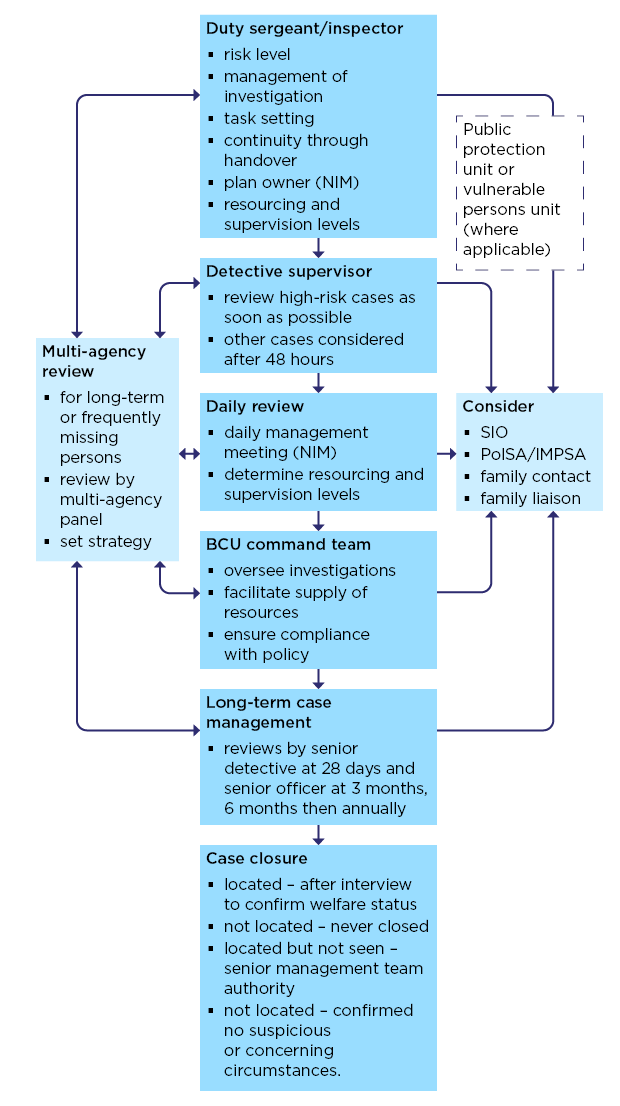
Early supervision
The initial supervision should be by sergeants and inspectors. Their responsibilities include the following:
- Supporting call handlers to ensure that sufficient time is given to gather all relevant information. The officer’s assessment of risk should be checked, verified and recorded on the appropriate form. In high-risk cases, supervision should be immediate. In all other cases, this should be done as soon as practicable.
- Ensuring that the appropriate actions are taken to locate the missing person without delay.
- Considering the need for an early media release where appropriate and advise corporate communications departments.
- Involving a detective, police search adviser (PolSA), senior management team and child-specific services. This is particularly important where serious crime or terrorism is suspected.
- Allocating sufficient resources to allow for effective investigation.
- Considering the need for a multi-agency response involving partner organisations in the investigation.
An immediate and longer-term investigation plan may be set by a supervisor or investigating officer. Any plan should take account of staffing levels and should be recorded. Such entries should be timed, dated and signed by the supervisor.
The investigation plan should document the risk assessment guiding the actions being set and any lines of enquiry. Supervisors should ensure that these are revisited as new information is received or circumstances change.
The next duty supervisor should be fully briefed to ensure continuity of the investigation. The tasking and coordination group should monitor missing person investigations, ensuring that they are being managed effectively with appropriate levels of resources.
A model of supervision