
Practice note: understanding the effectiveness of slavery and trafficking risk orders
Slavery and trafficking risk orders
Published on
Written by Detective Chief Superintendent Neil Ralph, Head of South West Police Collaboration
Going equipped
4 mins read

For a couple of years now, I’ve been very interested in the impact that ancillary orders can have on policing outcomes. There’s a growing body of research indicating that these orders can be used effectively to reduce crime.
In a previous role, I chaired an anti-slavery partnership. I was extremely interested to find out if slavery and trafficking risk orders could reduce crime harm and crime volume.
Background
There are two civil orders available under Part 2 of the Modern Slavery Act 2015. These can restrict defendants who pose a risk of committing modern slavery offences in the future and protect those at risk:
- slavery and trafficking prevention orders (STPOs)
- slavery and trafficking risk orders (STROs)
STROs are aimed at individuals who have not been convicted of a slavery or human trafficking offence, but where there is evidence that they pose a risk of harm. They are civil orders and the standard of proof is to the civil standard. This is ‘on the balance of probabilities’, which is a lower tariff than the criminal standard. For an STRO, evidence of the alleged behaviour needs to be put before a court.
For example, one real-life case concerned an organised crime group (OCG) exploiting vulnerable teenagers. The STRO stated that an individual could not:
- enter a defined area
- contact children under the age of 18 years (with very limited exceptions)
- interact with a named child
- supply devices to minors
- own a mobile phone, unless a specified registration process was followed
There was not initially enough evidence to gain a criminal charge. However, the subject then breached the STRO three times in the four days after it was issued, which led to them being arrested, remanded and deported. This highlights the efficacy and potential of STROs to disrupt criminal activity and protect vulnerable people.
Methodology
After an initial literature review, I could not identify any empirical research on this topic. Working with the brilliant Lara, Emma, Niamh and Ruth, we set out to provide evidence that would help policing understand the efficacy of STROs.
In 2023, we obtained a list of every STRO issued in the UK, which totalled 114. To compare crime volume and crime harm, we identified a time period of two years before the STRO was issued and two years after. This resulted in a sample of 49 STROs to analyse. Arrests were used as the measure of criminality, both:
- by volume (number of arrests)
- by harm, using the Cambridge Crime Harm Index (CCHI) to assign a crime harm score to each arrest
STRO record checks were manually conducted in the Police National Computer (PNC) and the Police National Database (PND). However, initial data cleansing found inaccuracies between the two systems.
To optimise accuracy, we sent data requests to regional organised crime units (ROCUs) to retrieve data from force systems. This caused delays and created room for human error. Because of poor data quality, we asked the relevant regions for the following information:
- STRO start date
- length of STRO
- offending history (two years pre-STRO and post-STRO)
- STRO conditions
41 STROs were eligible for analysis. Once the team were confident in the data, we reviewed everything with colleagues from the University of Exeter, who kindly provided further advice and guidance.
Results
There were 210 offending events in the two-year period before STROs were issued, compared with 93 offending events in the following two years. There was a statistically significant reduction in the number of offending events across all categories that were analysed:
- overall (56%)
- modern slavery (52%)
- violence (50%)
- drugs (58%)
- other (65%)

Similarly, the reduction in total harm (using CCHI) was statistically significant across all categories analysed:
- overall (83%)
- modern slavery (92%)
- violence (60%)
- drugs (64%)
- other (99%)

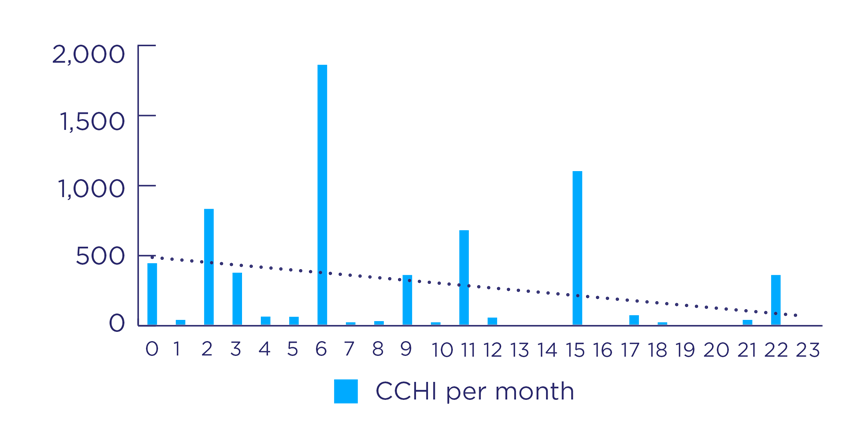
In the two years after STROs were issued, there was a statistically significant downward trend in total harm per month. This trend was gradual and not stepped, meaning that the positive effect of STROs appears to continue with time, rather than wearing off. There was also a statistically significant downward trend for offending events.
Conclusion
While we cannot assume causality, there were large reductions in both crime volume and crime harm in the two years after an STRO was issued. This provides a persuasive narrative for the impact that STROs can have to reduce offending. We observed that:
- there is a significant positive correlation between offending events and harm, as offending decreases, harm decreases
- there was a statistically significant reduction in offending volume and crime harm after an STRO was issued
- there was a statistically significant downward trend in offending events and crime harm after an STRO was issued
- the effect of STROs is greater on crime harm than it is on offending volume
- our research highlighted the poor data quality held in relation to STROs on policing systems
Recommendations
- Forces and related law enforcement agencies should consider issuing more STROs to prevent and reduce crime (see the Modern Slavery Act 2015 for more information).
- Policing should assess how information and data is recorded, collated and stored on national systems.
- More research in this area would be beneficial, as would looking at other ancillary orders, to identify whether there are other orders that are effective in reducing or preventing crime.
This article was peer reviewed by Detective Constable James Rudge, National County Lines Coordination Centre. You can contact James for further information and subject matter expert advice, at [email protected]
Detective Chief Superintendent Neil Ralph would like to thank the following colleagues for their contribution to this research:
- Lara Barrett, Trainee Financial Investigator, South West Regional Organised Crime Unit (SWROCU)
- Emma Bailey, Data Insight Analyst, SWROCU
- Niamh Bailey, Intelligence Researcher, SWROCU
- Ruth Bailey, Specialist Problem Solver, Devon and Cornwall Police